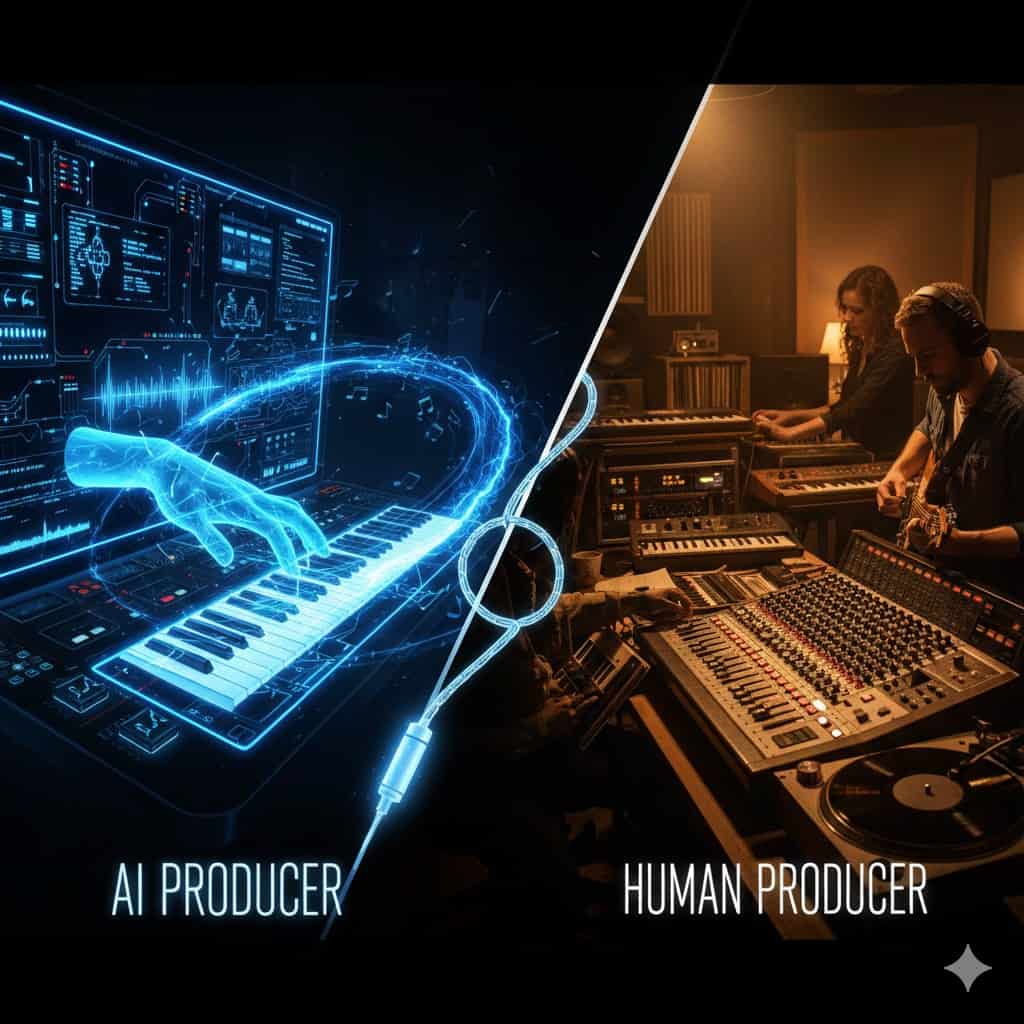
The question of whether AI will replace human musicians has shifted dramatically over the past year. Rather than a simple yes-or-no answer, the evidence from 2025 reveals a more nuanced reality: AI is not replacing musicians, but rather fundamentally reshaping how they work, what skills matter, and which creative spaces remain uniquely human.
The Current State: AI as Augmentation, Not Replacement
Current data reveals a critical pattern in how professionals actually use AI. Research shows that 87% of producers incorporate AI into their workflows, yet only 13% use AI to generate an entire song autonomously. Instead, 79% use AI for technical tasks like mixing and mastering, 66% use it creatively for songwriting or instrumentals, and 52% use it for visual and promotional work. This distribution tells a clear story: AI functions best as a specialized tool within human-directed creative processes, not as an autonomous replacement.
Where AI Genuinely Excels
Speed and Volume Production represents AI’s most dramatic advantage. A single human composer might complete one polished track weekly; AI can generate hundreds of variations in minutes. This efficiency is transformative specifically for commercial applications—advertisements requiring quick turnaround, background music for video creators, podcast intros with tight deadlines, and corporate presentations needing functional soundtracks. The cost differential is staggering: traditional composers charge $1,000-5,000+ per track, while AI delivers results at $10-30 monthly subscriptions.
Democratization of Music Creation has genuinely occurred. Individuals without formal music training can now produce technically competent background music, demos, and reference tracks—something impossible five years ago. A 2024 study found 68% of independent creators use AI because it’s cost-effective. This democratization particularly benefits underrepresented artists in developing nations, small business owners, and hobbyists who previously lacked resources for professional production.
Consistency and Technical Proficiency distinguishes AI from human variability. Every AI-generated track receives the same polished mixing, professional audio quality, and harmonic consistency. For functional music—background scoring, mood-based playlists, atmospheric content—this predictability is an advantage. Human producers occasionally produce mediocre work due to fatigue, creative blocks, or technical errors; AI avoids this variance.
Rapid Iteration and Creative Blocks show measurable productivity gains. A University of Amsterdam study found that creators using AI music tools saw a 20% boost in productivity and creativity. The practical benefit: when a human composer faces writer’s block, AI can generate dozens of chord progressions, melodic variations, or production ideas in seconds, helping them break through creative paralysis and explore unfamiliar territories.
Components Over Whole Tracks represent where AI performs most effectively. Rather than full-song generation, the most successful AI adoption involves generating individual elements—drums, bass lines, chord progressions, vocal harmonies—that human artists then customize, arrange, and layer with personal touches. This hybrid approach leverages AI’s speed while preserving human creative control.
Where AI Fundamentally Falls Short
Emotional Authenticity and Lived Experience represent the deepest limitation. AI operates through algorithmic pattern-matching; it can identify that minor keys frequently appear in melancholy songs or that specific chord progressions correlate with sadness. Yet it cannot feel these emotions. The difference is profound: when a human artist writes about heartbreak, they draw from personal pain, memory, and vulnerability. Their authenticity resonates because listeners perceive genuine human experience behind the music. AI, by contrast, simulates emotional patterns without any subjective consciousness or lived reality to ground them. This fundamental gap explains why listeners consistently describe AI music as technically impressive but emotionally “soulless.”
Cultural Context and Meaning-Making elude AI systems. Music carries cultural significance, historical weight, and contextual meaning that algorithms cannot grasp. A protest song gains power from the historical moment and cultural struggle it addresses. A folk melody connects listeners to ancestral traditions and communal identity. A jazz improvisation reflects lived cultural experience within a specific tradition. AI-trained on global music patterns cannot understand why these elements matter or how to wield them meaningfully; it can only recognize correlations.
Intentional Rule-Breaking and Innovation remain exclusively human domains. Avant-garde and experimental music, by definition, violates established conventions. A composer might deliberately use atonality, microtonal tuning, irregular time signatures, or extended techniques because they serve artistic vision—they challenge the listener and convey something rule-following music cannot. AI, trained on existing musical patterns, reproduces familiar structures rather than breaking them intentionally. When AI breaks rules, it does so accidentally through processing errors or training data gaps, not through deliberate artistic choice.
Personalized Narrative and Storytelling depend on subjective consciousness. Great songwriting weaves personal story—a specific relationship, a particular struggle, a unique perspective—into lyrics and music. While AI can generate grammatically correct lyrics about generic heartbreak, it cannot infuse them with the particular details, emotional weight, and personal voice that make human songwriting resonate. The difference between an AI-generated breakup song and one written by someone processing actual heartbreak is the difference between a technical simulation and genuine expression.
Micro-Timing and Performance Nuance communicate emotion through subtlety. Human musicians instinctively use slight deviations from perfect tempo, delicate variations in vocal vibrato, strategic pauses, and dynamic shifts to convey feeling. These “imperfections” are precisely what makes performances emotionally powerful. AI can be trained to replicate these patterns, but it applies them algorithmically rather than with intuitive understanding of when and why they matter. This mechanical application often feels forced or unnatural compared to intentional human choices.
The Economics Reality: A More Complicated Picture
The financial impact mirrors the technical reality: AI reshapes rather than eliminates. The concerning findings from 2025 research reveal genuine economic pressure: by 2028, 23% of music creators’ revenues will be at risk due to generative AI, representing over AUD$519 million in cumulative damage. France and Germany alone face projected revenue losses of €950 million by 2028 if fair compensation systems aren’t implemented.
However, this doesn’t translate to musician extinction. Rather, three distinct tiers are emerging:
Top-tier professional composers—those creating film scores, orchestral works, or commercially successful albums with devoted audiences—face minimal replacement threat. Their brands, stylistic signatures, and emotional depth command premium rates. Audiences specifically seek their work. Mid-level session musicians and generic commercial composers, however, face significant pressure. If AI can produce adequate background music or formulaic pop tracks at 1% of the cost and in 5% of the time, commercial buyers will increasingly choose AI. This segment will contract substantially.
Independent artists and hobbyists benefit substantially. AI provides access to professional-quality production tools previously unavailable. Rather than replacing them, AI becomes their competitor’s tool, leveling playing fields.
The Hybrid Future: AI as Creative Collaborator
The emerging consensus across 2025 reflects a fundamentally different model than replacement. 71% of producers already use AI in their workflows, and the overwhelming pattern shows AI enhancing rather than displacing human creativity. Professional musicians increasingly adopt a co-production approach:
Phase 1: Rapid Ideation. Generate 5-10 full instrumental variations in 15 minutes using Suno or Udio to explore structural possibilities and overcome creative block. Phase 2: Selective Curation. Choose the strongest variation based on human aesthetic judgment. Phase 3: Hybrid Development. Export stems, import into a DAW, replace weak AI elements with personal recordings (vocals, guitar, unique production choices), extend sections, reorganize structure. Phase 4: Professional Enhancement. Apply mixing, effects, and mastering to elevate raw output to release-quality standards.
This workflow delivers profound efficiency gains—reducing production time from weeks to days—while maintaining creative authenticity and unique artistic vision. Projects like Google’s Magenta Project and OpenAI’s Jukebox were specifically designed for this collaboration model, enabling artists to use AI for ideation while maintaining full creative control over final output.
What Remains Uniquely Human
Live Performance and Stage Presence represent an AI-impervious domain. Watching a guitarist’s technique, a vocalist’s connection with audience, the spontaneous improvisation responding to crowd energy—these elements cannot be bottled into algorithms. Even advanced robots cannot replicate the charisma, presence, and genuine moment-to-moment human connection of live performance.
Genre Innovation and Artistic Movements depend on humans deliberately choosing to break established patterns. Every major musical innovation—jazz, rock, electronic music, hip-hop—emerged from humans intentionally violating previous conventions. AI can explore patterns within its training data but cannot invent genuinely new paradigms.
Conceptually Complex and Thematically Ambitious Work requires subjective consciousness. Concept albums exploring psychological themes, protest albums addressing social injustice, autobiographical narratives—these demand the kind of sustained artistic vision and personal investment that humans uniquely possess.
The Copyright Complication
One critical factor shaping AI’s role is the unresolved copyright landscape. Major lawsuits between music publishers and AI companies (UMG vs. Suno/Udio) continued through 2025, with UMG and Udio reaching a landmark settlement in October 2025, announcing plans for a licensed AI-powered music platform launching in 2026. This licensing shift matters profoundly: platforms training exclusively on authorized, licensed music will necessarily produce less derivative work, making their outputs less directly competitive with existing catalog music.
The legal and ethical framework is still forming in 2025, but the direction is clear: unlicensed training on copyrighted material faces mounting legal jeopardy, while licensed AI platforms will coexist with human creators rather than replacing them wholesale.
Realistic Predictions for Different Music Sectors
Commercial Background Music and Functional Audio: AI increasingly dominates. Background music for ads, podcasts, videos, hold music, and corporate settings will shift heavily toward AI within 3-5 years. Human composers in this sector need alternative value propositions (unique artistic voice, live performance capabilities, strategic positioning in higher-value markets).
Pop Music and Commercially Formulaic Genres: Significant AI encroachment expected, but not replacement. AI will produce serviceable pop hits for commercial use, but audiences increasingly value authenticity and artist personality. Successful pop artists will likely incorporate AI as production tools while maintaining personal brand and performance capabilities.
Classical and Orchestral Composition: Slow, limited replacement. These domains require deep technical knowledge and established traditions that AI can simulate but not innovate within. The classical audience values human composers with credentials and artistic vision.
Experimental, Avant-Garde, and Innovative Genres: Remain human-dominated. These genres explicitly celebrate rule-breaking and human creativity. AI has minimal competitive advantage here.
Live Performance and Touring: Exclusively human domains. No AI can replace the energy, connection, and spontaneity of live performance.
What Professional Musicians Should Actually Worry About
Rather than wholesale replacement, the legitimate concerns are:
Skill Devaluation: Basic technical competencies in mixing, mastering, beat-making, and arrangement—skills that took years to develop—now emerge from five-minute prompts. This devalues credentials and training. However, this mirrors previous technological disruptions (recording technology, synthesizers, DAWs) that eliminated certain roles while creating others. Oversupply and Price Compression: As AI floods stock music libraries and streaming platforms with acceptable content, commercial rates for background music, library music, and service work will compress further. Attention Economy Competition: Listener attention is finite. More accessible music creation means vastly more music competes for attention. Standing out requires differentiation beyond technical proficiency. Replacement in Specific Segments: Truly generic work—royalty-free background music, stock commercial tracks, AI-generated playlist filler—will migrate to AI. Work with clear commodity characteristics faces real replacement pressure.
The Path Forward: Strategic Adaptation
Musicians adapting successfully in 2025 do so by:
Emphasizing Unique Voice and Authenticity: Verified human compositions increasingly command premium licensing rates as platforms prioritize “authentic” music in discovery algorithms. Hybrid Competency: Mastering AI tools alongside traditional skills creates powerful competitive advantages. Producers understanding both AI capabilities and limitations, and knowing how to integrate AI into professional workflows, dramatically increase output and efficiency. Live Performance and Connection: Artists building touring careers, merchandise, and direct fan relationships create revenue streams AI cannot touch. High-Complexity, High-Concept Work: Concept albums, soundtrack scoring for major productions, and thematically ambitious projects remain firmly human domains requiring sustained artistic vision. Niche Expertise: Specializing in specific cultural traditions, underrepresented genres, or technically challenging domains provides defensibility against AI competition.
The Verdict
AI will not replace musicians. Instead, it will accelerate stratification, eliminate commodity work, and force the industry to more clearly delineate the economics of human artistry.
The future likely involves: A smaller population of musicians creating background/functional music, as AI dominates that segment. A robust population of professional musicians whose value derives from unique voice, live performance, cultural significance, or thematic ambition—work AI cannot replicate. A vastly larger population of AI-augmented hobbyists and amateur creators producing for personal satisfaction and small audiences. A complicated legal and licensing framework balancing innovation access with artist compensation.
The bottom line: musicians who survive and thrive in the AI era are those offering something irreducibly human—emotional authenticity, cultural significance, live connection, or innovative vision. Technical proficiency alone becomes insufficient. The technology forces the question music always contained: What makes music matter? The answer, increasingly, points toward human experience, vulnerability, and meaning-making—precisely what algorithms cannot provide.