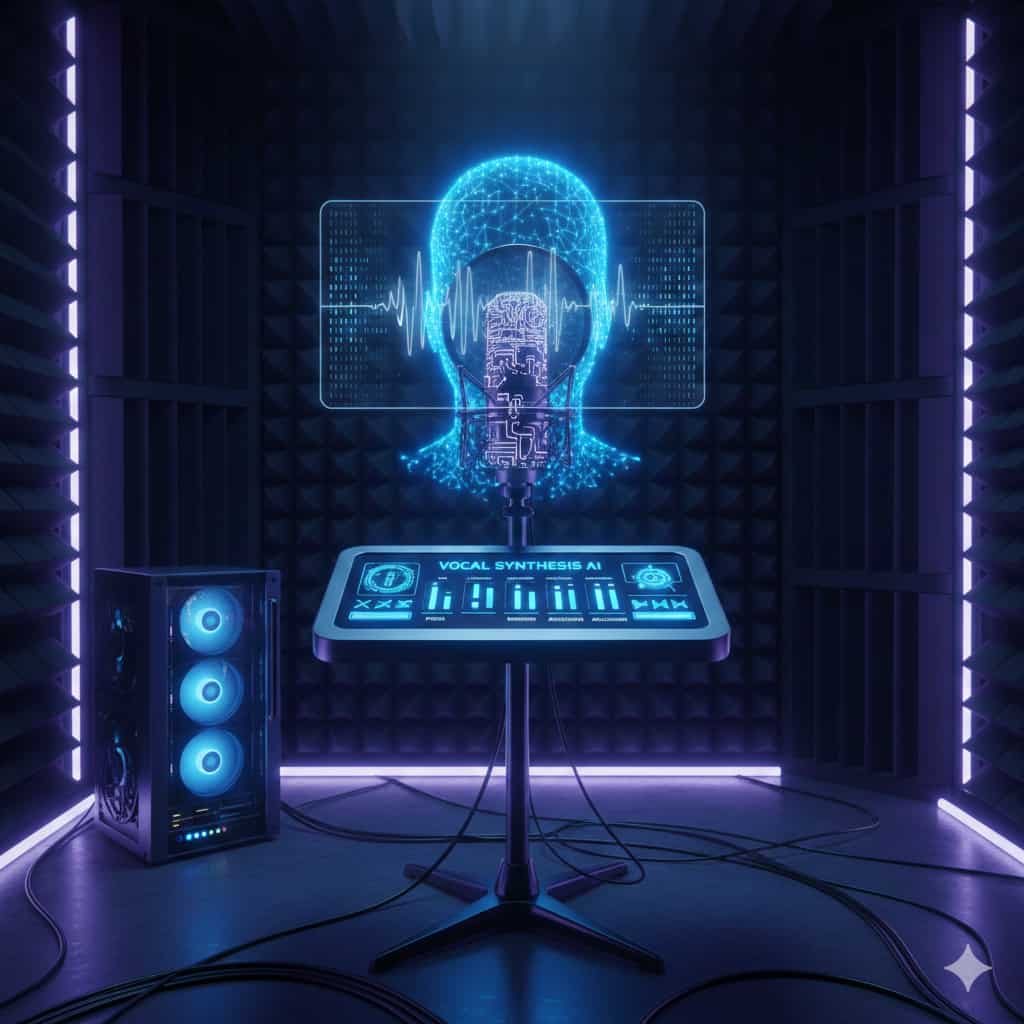
AI voice generation for music has evolved from a novelty into a sophisticated production tool, yet the landscape remains complicated by ethical ambiguities and rapidly-evolving legal frameworks. Creating professional AI vocals requires understanding not only technical capabilities but also navigating complex rights issues, consent requirements, and emerging regulations that vary dramatically across jurisdictions.
Top AI Vocal Generation Platforms
Suno AI remains the most accessible entry point for complete AI-generated vocals. Rather than requiring pre-written melodies or vocal techniques, Suno generates full lyrics, melodies, and vocal performances simultaneously from text descriptions. The platform supports 10+ languages and produces studio-quality vocals suitable for independent releases. The free tier provides 50 credits daily (roughly 10 songs), while the $10/month Basic plan grants 500 songs monthly.
Suno’s v4.5+ models deliver the most convincing vocal performance among free-tier generators, with natural phrasing, emotional expression, and genre-appropriate vocal characteristics. The 8-minute song capability enables full-length compositions with verses, choruses, and bridges synthesized coherently. For beginners wanting complete songs without recording experience, Suno excels.
Critical limitation: Purely AI-generated vocals can sound remarkable in isolation but often lack the subtle imperfections and personality that characterize human singing. The technical perfection can paradoxically feel less emotionally resonant than imperfect human performances.
ElevenLabs Music emerged as the commercial-focused alternative, emphasizing licensing legitimacy through trained models using only authorized, licensed music data. The platform produces exceptionally clean, professional-sounding vocals with extensive multilingual support (29+ languages). Pricing ranges from $8/month (limited generation) to $250/month (professional plans).
The October 2025 UMG settlement strengthened ElevenLabs’ position, establishing them as a legitimate licensing partner rather than a copyright-circumventing tool. For creators prioritizing legal certainty and commercial viability, ElevenLabs’ licensing-first approach provides genuine protection.
Trade-off: Pricing significantly exceeds Suno’s free tier, and the interface emphasizes commercial use rather than experimentation.
Kits AI specializes in voice cloning combined with music generation. Upload vocal samples (as little as 10-20 seconds of reference audio), and Kits creates a custom AI voice model trained on your sample, then generates new singing using that voice. This enables creating AI vocals that sound like you, a singer you admire (with consent), or entirely original synthetic voices. The $115/year subscription provides custom voice model training and unlimited generation.
The platform excels for artists wanting consistent vocal identity across multiple generated songs without recording each performance.
Synthesizer V Studio 2 Pro and ACE Studio represent professional-grade options for composers and music producers demanding granular vocal control. Both platforms use timeline-based editors enabling note-by-note editing—adjusting pitch, vibrato, emotional tone, and phoneme articulation at DAW-like precision levels.
Synthesizer V ($99 perpetual license) produces remarkably natural emotional expression through vocal morphing capabilities, while ACE Studio ($398 one-time) emphasizes phoneme-level editing for absolute control. These platforms suit experienced producers who already understand music production fundamentals, whereas they frustrate beginners with their steep learning curves.
Vocaloid 6 and its famous virtual singers (Hatsune Miku, Crypton Future Media voices) target creators wanting distinctive aesthetic vocal characteristics. Rather than realistic human imitation, Vocaloid excels at stylized, recognizable synthetic vocal personas ideal for anime-inspired music, electronic production, and experimental genres. At $225 perpetual, Vocaloid represents strong long-term value for committed creators.
Critical distinction: Vocaloid requires MIDI sequencing knowledge (understanding musical notes and timing)—far steeper entry barrier than Suno’s text-based approach.
Voice Cloning: Technical Capability vs. Legal Reality
Voice cloning—creating convincing synthetic replicas of specific individuals’ voices—represents AI vocal technology’s most legally fraught frontier. Technically, the capability is mature: as little as 10-30 seconds of reference audio enables creating indistinguishable voice replicas. Yet the legal and ethical landscape remains chaotic.
The Critical Distinction: Copyright law protects specific sound recordings (the fixed expression), not voice itself. A 2025 New York federal court ruling (Lehrman & Sage v. Lovo) established that cloned voices do not constitute copyright infringement, because copyright protects the recording, not the abstract vocal characteristics. This gap between technical capability and legal protection creates genuine risk for both creators and platforms.
What This Means: Technically, you could create AI covers of famous singers’ voices without infringing copyright. Legally and ethically, however, you likely violate personality rights, ELVIS Act protections, and emerging anti-deepfake legislation.
Legal Landscape: Where You Can and Cannot Clone Voices
The legal framework varies dramatically by jurisdiction, creating genuine compliance complexity:
Tennessee’s ELVIS Act (Effective July 2024): The most restrictive jurisdiction explicitly protects voices as personal property. The law criminalizes unauthorized voice cloning for commercial purposes, with penalties of up to 11 months, 29 days in jail and/or $2,500 fines for violations. “Commercial purposes” encompasses far more than obvious uses—social media posts with commercial intent, brand videos, and AI-generated music for distribution likely qualify.
Importantly, the ELVIS Act requires explicit consent before voice cloning, even for entertainment purposes. Creating an AI cover of someone’s voice without permission, even non-commercially, violates the law.
EU AI Act (Effective January 2026): Europe’s comprehensive AI regulation mandates explicit opt-in consent before any biometric data use, including voice processing. All synthetic content must be clearly labeled as AI-generated. Violations risk fines up to €20 million or 4% of global annual revenue, whichever is larger. The EU effectively bans voice cloning without affirmative consent—no “assume consent” loopholes exist.
Illinois Biometric Information Privacy Act (BIPA, Effective 2008): Illinois classifies voiceprints as biometric data requiring explicit opt-in consent. Over 1,000 BIPA lawsuits have been filed since 2015, with class action settlements exceeding $650 million cumulatively. Non-compliance carries enormous class action risk for Illinois-based companies.
United Kingdom Copyright Law: Unlike the U.S., UK copyright law explicitly permits copyright protection for AI-generated works, providing creators with stronger protections. However, voice cloning still requires authorization under personality rights protections.
United States Copyright Law: The U.S. Copyright Office explicitly states that purely AI-generated works cannot receive copyright protection, though works with substantial human creative input may qualify. This creates a perverse incentive: human-created works receive stronger protection than AI creations, but voice cloning itself isn’t directly prohibited by copyright (only by emerging state laws like ELVIS).
Pending Legislation: California and New York are considering ELVIS Act equivalents, likely passing in 2025-2026. Once adopted by multiple major states, voice cloning without consent will face consistent nationwide liability risk.
Ethical Concerns Beyond Legal Compliance
Legal compliance, while essential, represents only one layer of ethical responsibility. Several concerns transcend jurisdictional law:
Consent and Information Asymmetry: The fundamental ethical issue: does the voice owner understand what they’re consenting to? Many consent forms use vague language like “use in AI-related projects” without specifying precise applications. Industry best practices (United Voice Artists guidelines) require specific, revocable consent describing exact use cases, territories, and duration. Generic blanket consent violates ethical principles even where legally permissible.
Deepfake Misuse and Fraud: AI voices enable voice-impersonation fraud at scale. A 2023 CEO fraud case used AI voice impersonation to execute $243,000 fraudulent transfers. More broadly, deepfake songs impersonating famous artists threaten intellectual property rights and listener trust. The 2025 MIREX challenge specifically addresses Song Deepfake Detection, reflecting industry recognition of this threat.
Artistic Attribution and Credit: If you create music using someone’s AI-cloned voice, does the original voice owner deserve credit or royalties? Current law is unclear. Ethically, the person whose voice was cloned contributed to the artistic work—they deserve attribution and potentially compensation. The emerging consensus (UVA guidelines, licensing frameworks) requires explicit credit and usage-based compensation, not one-time buyouts.
Consent from Minors: Voice cloning of minors raises heightened concerns around consent capacity and long-term implications. Best practices require parental/guardian written consent for any minor voice cloning. Many jurisdictions will likely codify this into law.
Best Practices for Ethical AI Voice Use
Whether creating your own AI vocals or using others’ voices, following these principles protects both parties:
1. Obtain Explicit Written Consent:
- Get written, auditable consent from any person whose voice is cloned
- Specify exact use cases: “podcast intros in English and Spanish,” not “AI-related projects”
- Include territory limitations: “North American distribution only,” not “worldwide”
- Include duration limits: “valid for 2 years,” not perpetual
- For minors, require guardian approval
2. Include Revocation Rights:
- Voice owners must be able to request takedown anytime
- Establish clear revocation process: notice period, model deletion timeline
- Document revocation and enforce it across all platforms
- Plan for remediation costs if violations occur
3. Provide Transparent Disclosure:
- Label all synthetic vocals as “AI-generated”
- Include generation method: “voice cloning using [Name]’s sample”
- Disclose to listeners, not just in fine print
- EU AI Act (effective 2026) makes this legally required
4. Establish Fair Compensation:
- Don’t treat voice cloning as one-time buyout
- Compensate based on actual usage: social media reach, streaming numbers, licensing scope
- Follow UVA compensation principles: creation fee + usage royalties + ongoing fees for continued use
- Differentiate between exclusive (no one else can use that voice) and non-exclusive licensing
5. Secure Voice Data:
- Encrypt voice recordings and models
- Limit access to authorized personnel
- Conduct regular security audits
- Establish breach notification protocols
- Comply with GDPR and AI Act data protection requirements
Practical Workflow: Creating AI Vocals Legally and Ethically
For Your Own Voice:
No consent issues exist—you own your voice. Generate AI vocals freely:
- Record 30-60 seconds of clean vocal audio
- Upload to Kits AI or Synthesizer V Studio
- Create AI voice model from your sample
- Generate new songs using your custom voice model
- Modify pitch, emotion, and delivery at phoneme level if desired
- Export and use commercially with no restrictions
This approach enables creating consistent vocal identity across multiple songs without recording each performance.
For Using Others’ Voices:
Explicit consent is essential. The process should be:
- Identify voice owner and their rights holder (artist, label, etc.)
- Draft consent agreement specifying: use cases, territories, duration, revocation rights, compensation
- Obtain signed consent from voice owner (or their representative)
- Store consent documentation securely for audit purposes
- Arrange compensation upfront and ongoing based on usage scope
- Label content disclosing AI generation and voice source
- Establish monitoring to detect unauthorized additional uses
- Plan revocation response for if/when voice owner requests takedown
Common Beginner Mistakes
Assuming No One Will Know: Deepfake detection technology is improving rapidly. The 2025 MIREX challenge specifically addresses song deepfake detection—by 2026-2027, platforms will likely detect unauthorized voice clones automatically.
Using Celebrity Voices Without Consent: Even if undetectable, ELVIS Act violations carry criminal penalties. Tennessee prosecutors have shown willingness to enforce, and other states will follow.
Generic Consent Forms: Vague “AI use” consent doesn’t protect you legally or ethically. Courts increasingly scrutinize consent specificity.
Ignoring Revocation Rights: If a voice owner requests takedown, comply immediately. Continued distribution after notice significantly increases liability.
Moving Forward: Predictions and Recommended Actions
By 2026-2027, voice cloning without explicit consent will likely face legal jeopardy in most U.S. states and Europe. The trajectory is clear: voice is becoming legally and practically treated as personal property requiring consent-based licensing.
For Creators: Invest in learning AI vocal tools using your own voice (Kits AI, Synthesizer V) where consent is automatic. If using others’ voices, establish legitimate licensing agreements reflecting emerging standards.
For Platforms: Implement robust consent verification, revocation mechanisms, and synthetic content labeling. Platforms demonstrating strong compliance will attract legitimate creators and avoid regulatory backlash.
For Voice Owners: Understand your rights under ELVIS Act and emerging state laws. Consider proactive licensing agreements rather than reactive cease-and-desist letters.
The AI voice generation landscape is simultaneously empowering (unprecedented creative access) and legally fraught (unclear rights). Success requires combining technical capability with ethical rigor and legal compliance—a challenging but essential balance in 2025 and beyond.