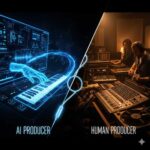
The copyright landscape for AI-generated music has crystallized dramatically in 2025, with landmark rulings, major licensing settlements, and active litigation reshaping who owns what. Rather than legal chaos, a clear framework has emerged: human authorship determines copyright ownership, training data licensing is mandatory for commercial AI platforms, and musicians have genuine protections—if they understand and implement them.
The Fundamental Rule: Human Authorship = Copyright Ownership
The January 2025 U.S. Copyright Office ruling established the definitive standard: AI-generated music receives copyright protection only when it contains substantial, demonstrable human authorship.
This means:
Fully AI-Generated (Unmodified) = No Copyright: Press “generate,” accept the output unchanged, and the result is automatically public domain—anyone can use, remix, or commercialize it without permission or payment. This includes works from all AI music generators (Suno, Udio, MusicGen) if used raw. This principle applies globally, not just the U.S.
AI + Human Contribution = Copyrightable: The moment you add meaningful human elements—rewrite lyrics, arrange sections, record vocals, edit MIDI, adjust instrumentation—the work qualifies for copyright. The Copyright Office explicitly states that “AI-assisted works can be copyrighted when there is substantial human creativity involved.”
What Counts as “Substantial Human Authorship”?: Courts and the Copyright Office evaluate case-by-case, but the bar is clearer in 2025:
| Human Action | Copyright Eligible? | Why |
|---|---|---|
| Writing text prompt | NO | Prompts alone don’t constitute authorship |
| Editing AI output substantially | YES | Human modification shows creative control |
| Recording vocals over AI instrumental | YES | Human vocal performance |
| Rearranging sections or extending | YES | Human arrangement decisions |
| Changing melody or harmony | YES | Human creative modification |
| Minor tweaks (volume, fade) | MAYBE | Depends on extent; document everything |
| Using completely raw AI output | NO | No human authorship present |
Critical phrase from Copyright Office: “Meaningful human authorship is the test. Minimal input does not constitute authorship.” The question for each registration: Did the human exercise creative control over expressive elements (melody, harmony, arrangement, production choices), or merely select an AI option?
The Documentation Imperative
Because the Copyright Office evaluates human authorship case-by-case, documentation becomes legally critical. Without evidence proving human authorship, your copyright claim will be rejected.
Essential Documentation:
- Screenshots of your creative process: Before/after comparisons showing AI output and your modifications
- DAW session files: Containing MIDI edits, vocal recordings, arrangement changes with timestamps
- Production notes: Explaining creative decisions—why you changed melody, rearranged sections, what artistic intent drove modifications
- Original prompt and iterations: Show that you refined and directed the AI through multiple generations
- Metadata with copyright notice: Label tracks clearly as “AI-assisted” with your copyright claim
- Version history: Demonstrate iterative creation process, not one-step generation
Example Documentation Workflow:
- Save AI-generated stems with timestamps
- Screenshot your prompt and AI output (before modification)
- Import into DAW and make edits—keep session file with all edits visible
- Record live vocals or add human elements—save original recordings
- Screenshot final mix showing all elements
- Write production notes explaining creative decisions
- Register copyright with Copyright Office, submitting documentation showing human authorship
Why This Matters: The U.S. Copyright Office receives thousands of AI copyright registration attempts. Those with clear documentation showing human authorship get approved. Those with raw AI output get rejected. The distinction is documentation.
International Copyright Rules: Major Variations
While the U.S. standard is now clear, international rules diverge significantly, creating compliance complexity.
European Union (AI Act, Effective January 2026): The EU requires explicit labeling of AI-generated content and mandates that commercial AI training requires licensing agreements. Unlike the U.S., the EU permits some copyright protection for AI-generated works with human input, but training data licensing is legally mandatory for commercial use. Platforms must disclose what data was used to train models, and creators can request removal of their work from training datasets.
Germany (GEMA Active Enforcement): Germany’s GEMA (rights collective representing millions of musicians) filed the first major AI copyright lawsuit in January 2025 against Suno AI, documenting that Suno’s outputs closely replicate works by Alphaville, Lou Bega, and others. The lawsuit establishes that German courts will hold AI generators liable for copyright infringement, and GEMA is pursuing similar litigation against other unlicensed platforms. GEMA actively sues platforms using German composers’ works without licensing.
United Kingdom (Debate Ongoing): As of February 2025, the UK remains in negotiation about AI copyright frameworks. The House of Lords voted to reject the government’s proposed “opt-out” licensing model, favoring instead stronger protections requiring AI companies to license training data before use. Commercial use of copyrighted material for AI training currently requires licensing under existing law, though enforcement remains inconsistent.
Australia and Canada: Both nations are developing frameworks, but haven’t yet established definitive standards. Fair use principles similar to the U.S. are anticipated.
Key International Implication: If you’re releasing music internationally, assume the strictest standard applies. Obtain licensing if training data was unlicensed; document human authorship thoroughly; disclose AI use clearly.
The Training Data Crisis: Unlicensed Music at Scale
A parallel copyright issue involves what data AI platforms trained on—a legally fraught territory with massive ongoing litigation.
The Situation: Multiple AI music platforms (Suno, original Udio model, OpenAI’s Claude, Anthropic’s models) trained on copyrighted music without licensing agreements. They scraped entire catalogs from Universal Music Group, Warner Music, Sony Music, independent labels, and composer collectives—hundreds of millions of songs—to train generative models without permission or compensation.
2025 Lawsuits and Settlements:
- GEMA (Germany) filed lawsuit against Suno AI in January 2025, documenting Suno outputs directly replicate famous songs—landmark first major AI music copyright case in Europe.
- Universal Music Group & Udio: October 2025 settlement establishing first major licensing agreement; Udio will launch licensed platform in 2026 trained exclusively on authorized UMG music.
- Warner Music Group & Udio: November 2025 settlement similar to UMG agreement; licensed platform launching 2026.
- RIAA vs. Suno/Udio: Pending lawsuits claiming mass copyright infringement for training without licenses.
- Music Publishers vs. OpenAI/Anthropic: Multiple ongoing suits alleging copyright infringement of lyrics and compositions.
What This Means for Users: If you create music using an unlicensed AI platform (trained on copyrighted material without permission), the platform bears legal liability, not you. However, the platform’s vulnerability creates business risk—Suno faces potential shutdown or forced retraining, creating uncertainty for creators using its tools.
Safer Approach: Use platforms with confirmed licensing:
- ElevenLabs Music: Trained on licensed music; explicitly licensed for commercial use
- MusicGen: Open-source Meta model trained on licensed data; completely free
- Udio 2026 Licensed Platform: Launching with Universal and Warner agreements
Copyright Registration and Commercial Distribution
Should You Copyright Your AI-Assisted Music?
Yes, if you made substantial human contributions. Register with the U.S. Copyright Office (or equivalent international office). The registration protects your copyright claim, enables potential damages in infringement cases, and establishes legal presumption of ownership.
The Registration Process:
- Create your AI-assisted track with documented human authorship
- Visit copyright.gov and file registration online ($65)
- Submit track plus “Application for Copyright Registration for a Work of the Performing Arts”
- Describe human authorship specifically: “Lyrics by [Your Name], arrangement and production by [Your Name], vocal recording by [Your Name]”
- Attach documentation showing human contributions
The Copyright Office will evaluate whether your human contributions meet “substantial authorship” threshold. Clear documentation dramatically improves approval odds.
For Streaming Distribution: When uploading to Spotify, Apple Music, YouTube, declare copyright ownership and AI-assistance status in metadata. Platforms increasingly require disclosure of AI use, particularly following EU AI Act requirements.
Ownership: Who Owns Your AI-Generated Music?
The Default Rule: The Creator (You) Owns Generated Content
When you use AI tools to generate music, you own the generated output by default, regardless of platform terms, with important exceptions:
| Platform | Ownership Terms | Notes |
|---|---|---|
| Suno AI | User owns generated content | Stated in terms; not challenged |
| Udio | User owns content (1,200 credits plan+) | Free tier may have restrictions; verify terms |
| MusicGen | User owns content | Open-source; no platform ownership |
| Boomy | User retains all rights (free tier+) | Distributes to Spotify; user keeps publishing rights |
| ElevenLabs | User owns generated content | Explicitly stated in licensing terms |
Exception – Read Platform Terms Carefully: Some platforms or free tiers may claim partial rights or require licensing fees for commercial use. Before committing to a platform, review their terms—specifically looking for: “User owns generated content,” “Commercial use permitted,” “No licensing fees required.”
Pro Tip: For maximum legal protection, screenshot or save the platform’s terms of service at the time of creation. Platforms change terms, and having documentation of what you agreed to prevents future disputes.
Best Practices: Protecting Your Rights
1. Document Everything
- Screenshot AI prompts before generation
- Save before/after comparisons showing edits
- Keep DAW session files with all modifications visible
- Write notes explaining creative decisions
- Save metadata showing AI-assistance status
This documentation becomes evidence if copyright is ever challenged.
2. Add Genuine Human Elements
Don’t rely purely on AI output. Add:
- Original lyrics or significantly modified existing lyrics
- Your own vocal performance (even if AI-enhanced)
- Arrangement decisions changing section structure
- Instrumentation choices different from AI generation
- Production elements (effects, mixing decisions) reflecting your creative vision
Each human contribution strengthens copyright claim.
3. Register Copyright
For commercial releases, copyright registration ($65 per work) provides legal protection and presumption of ownership. Worth the investment if monetizing.
4. Use Licensed AI Platforms
Avoid platforms with known copyright infringement lawsuits (original Suno, original Udio, unlicensed versions of platforms). Prefer:
- ElevenLabs Music (licensed music)
- MusicGen (licensed open-source)
- 2026 Licensed Platforms (UMG/Warner agreements)
This protects you from platform shutdown or forced changes.
5. Disclose AI Use
Label tracks as “AI-assisted” on streaming platforms and in metadata. This is required under EU AI Act (effective 2026) and recommended best practice globally. Transparency avoids future liability.
6. Understand Your Platform’s Terms
Before using any platform extensively:
- Screenshot their terms of service
- Specifically identify ownership clauses
- Note any commercial licensing restrictions
- Document usage rights for distribution
Having this documentation prevents disputes later.
The Bottom Line: Your Copyright Protection Strategy
For Fully AI-Generated Tracks (No Human Input):
- These are automatically public domain—anyone can use without permission
- Don’t attempt copyright registration (will be rejected)
- Consider whether you want others using your work; if not, add human elements
For AI-Assisted Tracks (Human Contributions):
- Document human authorship thoroughly—this is the legal requirement
- Register copyright with Copyright Office for commercial releases
- Label as AI-assisted on distribution platforms
- Use licensed AI platforms to avoid legal uncertainty
- Keep production records forever—they prove your authorship claim
For Commercial Distribution:
- Choose platforms with clear licensing agreements (ElevenLabs, verified tools)
- Add substantial human elements (vocals, arrangement, lyrics)
- Register copyright before major release
- Declare copyright ownership and AI-assistance status in metadata
- Maintain all production documentation
Internationally:
- Assume strictest standard applies (EU requirements)
- Document human authorship rigorously
- Use licensed training data platforms
- Disclose AI use transparently
The harsh reality: Fully AI-generated music has no copyright protection and no legal value. The economic and legal advantage goes to creators who blend AI efficiency with human authorship, documented thoroughly, registered properly, and distributed through legitimate channels. The future of AI music favors not those generating most music, but those proving their creative contribution in legally defensible ways.