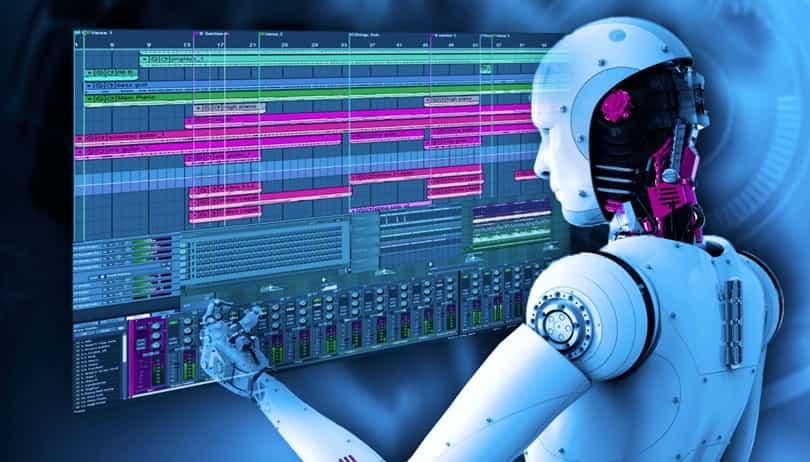
The music industry stands at an inflection point where artificial intelligence has transitioned from speculative future technology to operational business necessity. Rather than a gradual evolution, 2025 marks the year AI music technology achieved critical adoption mass across production, distribution, and monetization systems. The transformation is not monolithic—different industry segments experience AI’s impact differently, creating both unprecedented opportunities and genuine economic pressures.
Market Explosion: From Niche to Mainstream
The financial scale of this transformation reveals its magnitude. The global AI music market reached $6.2 billion in 2025, projected to expand to $38.7 billion by 2033—a tenfold increase within a decade. This represents one of the fastest-growing segments in entertainment technology. Generative AI music specifically, currently $0.92 billion in 2025, is expected to reach $10.2 billion by 2034, with an annual growth rate exceeding 25%.
More significantly, AI-generated music is projected to boost overall music industry revenue by 17.2% in 2025, creating new revenue streams through licensing agreements, royalty models, and novel business arrangements. This growth is not theoretical—adoption metrics show that 60% of musicians currently use AI tools, with 66% specifically adopting AI for music composition (as creative assistance rather than full generation).
The adoption pattern reveals critical nuance: 30.6% of artists use AI for mastering, 38% for artwork generation, but only 13% rely on AI for full song generation. This distribution reflects the industry’s view of AI’s genuine strengths—technical optimization and creative acceleration—versus its limitations. Creative assistance beats autonomous generation in adoption by a factor of five.
Shifting Adoption by Genre and Sector
AI adoption is not uniformly distributed across musical genres and industry segments. Electronic music leads with 54% adoption, driven by its inherent technological alignment and producer communities already embedded in digital workflows. Hip-hop follows closely at 53%, reflecting the genre’s historical embrace of production technology and sampling innovation. Advertising and commercial music shows 52% adoption, where AI addresses the acute pain point of rapid turnaround and cost efficiency—agencies require dozens of variations for A/B testing, a process AI executes in seconds.
By contrast, traditional and world music shows only 30% adoption, reflecting these genres’ emphasis on cultural authenticity, traditional instrumentation, and resistance to commodification through AI-generated content. This pattern reveals a genuine industrial schism: genre segments with established tradition and cultural significance maintain gatekeeping around AI adoption, while commercially-driven genres embrace technology’s efficiency gains.
Cloud-based solutions dominate the AI music landscape with 71.4% market share, reflecting the industry’s preference for browser-based access, no installation barriers, and real-time cloud processing over desktop software. This infrastructure advantage means AI music tools reach casual creators and small businesses more effectively than traditional expensive studio software.
Real-World Use Cases Reshaping Industry Segments
Video and Content Creation represents perhaps the highest-impact current use case. Content creators—YouTubers, TikTok creators, podcast producers, marketing agencies—require custom music quickly and affordably. AI music generators like Beatoven, Soundraw, and Mubert solve the acute pain point: previously, creators either used low-quality royalty-free music or invested thousands licensing custom composition. Today, they generate tailored soundtracks in minutes at negligible cost. For video creators particularly, AI tools enable music that responds to video pacing, mood, and emotional beats—something generic background music cannot deliver.
Gaming and Interactive Music illustrates AI’s capacity to solve problems humans cannot at scale. Open-world games require hundreds of hours of music tailored to varying environments, moods, and player contexts. Traditional orchestral scoring produces linear fixed tracks; AI enables dynamic, adaptive music that responds to player actions in real-time. As a player explores a calm forest, the music remains peaceful; upon encountering enemies, the AI generates urgent, intense variations instantly. This real-time responsiveness transforms immersion while reducing production costs by orders of magnitude. Major game studios, facing production schedules impossible with traditional composers, increasingly integrate AI music generation into development pipelines.
Streaming Platform Personalization fundamentally reshapes how billions of listeners discover music. AI algorithms analyze listening patterns, social context, temporal factors, and emotional indicators to create personalized playlists with precision impossible for human curation. Spotify’s “Discover Weekly” generates algorithmic recommendations based on listening history, enabling independent artists to reach audiences they could never reach through traditional gatekeepers. This disrupts traditional A&R models where major labels control artist discovery and visibility.
More controversially, AI now shapes what content streams recommend to users, potentially favoring AI-generated music over human artists when AI tracks cost platforms nothing in royalties while licensed music demands payment. Some playlists designated for relaxation, focus, or ambient music are increasingly populated with AI-generated tracks, creating potential revenue displacement for human artists in these genres.
Advertising and Commercial Audio shows the highest cost-driven adoption. Ad agencies need 10-20 soundtrack variations to A/B test creative approaches; hiring composers for each variation costs $5,000-20,000+ per track. AI generates all variations in minutes for $50-200 combined. This dramatic cost reduction ensures AI adoption becomes standard practice in commercial music production. For brands and agencies, the question shifts from “Should we use AI?” to “Why would we ever hire human composers again for this work?”
The Licensing Revolution: From Lawsuits to Collaboration
The most transformative 2025 development came through licensing agreements rather than technology itself. In October 2025, Universal Music Group reached a landmark settlement with Udio, establishing the first major licensing agreement for AI music training and generation. The agreement represents industry maturation: rather than fighting AI’s existence, major rights holders negotiated frameworks enabling controlled, compensated use.
The settlement’s terms establish a new 2026 platform trained exclusively on “authorized and licensed music,” ensuring legal legitimacy and artist compensation. This single agreement signals industry direction: future mainstream AI music platforms will be built on licensed training data, eliminating the “AI trained on unlicensed copyrighted material” model that defined 2024-2025 controversy.
UMG’s move demonstrates strategic thinking: licensing agreements generate new revenue streams from AI platforms while establishing competitive advantage through legal legitimacy. Smaller AI companies lacking licensing arrangements face mounting litigation risk. This creates a “licensing moat”—only well-funded platforms able to negotiate major label licensing agreements achieve mainstream viability.
The implications extend beyond business models. Licensed AI training produces less derivative similarity to existing catalog music (since training limited to authorized works creates more novel outputs). This paradoxically reduces direct competition between AI-generated and human-created music while establishing clearer IP boundaries and compensation mechanisms.
Business Model Innovation: From Transactional to Attribution-Based
The emerging dominant business model for AI-generated music moves beyond simple transactional licensing toward Attribution-Based compensation. Rather than paying flat fees or percentage shares regardless of actual influence, the model compensates rights holders proportionally to how their music influenced AI outputs.
This framework offers genuine advantages over streaming’s pro-rata model (where dividing total revenue across all songs disproportionately benefits high-stream-count music). Attribution Share addresses the “dilution effect” plaguing streaming: as AI generates millions of new tracks, each track receives smaller revenue share. Under attribution models, rights holders receive compensation based on measurable influence rather than consumption volume—creating stable, predictable revenue even as content volume explodes.
Implementation requires Dynamic Licensing APIs providing real-time asset control and Real-Time Attribution Dashboards showing precisely how different musical elements influenced generation. This technological infrastructure enables transparent compensation, addressing musician concerns about being exploited without visibility into how their work shapes AI outputs.
The Voice Cloning Dilemma: Technology Outpacing Law
Voice cloning represents the most ethically fraught frontier in AI music transformation. Using just minutes of vocal audio, sophisticated AI can replicate a singer’s tone, vibrato, pronunciation, and emotional delivery. This technology enables remarkable creative possibilities—artists can generate new performances without recording, deceased artists can receive new compositions, and rare historical voices can be preserved and extended.
Yet the legal landscape remains chaotic. Tennessee’s ELVIS Act criminalized unlicensed voice cloning, while EU legislation requires opt-out letters from major labels to AI developers. The U.S. Copyright Office’s 2025 report establishes that purely AI-generated works cannot receive copyright protection, while AI-assisted human creativity can. However, the critical gap remains: voice cloning without explicit consent generally violates personality and privacy rights, though enforcement remains inconsistent across jurisdictions.
The copyright distinction matters legally: an “AI cover” using a cloned voice isn’t considered a derivative work (protecting the original) because it lacks sufficient human authorship. This gap enables potentially exploitative use—generating songs that sound like famous artists without those artists’ consent or compensation. Current solutions include opt-in/opt-out licensing frameworks (requiring consent before voice training or generation), but enforcement depends on platforms’ willingness to implement controls.
By late 2025, no universal consent framework existed despite the technology’s rapid proliferation. This represents genuine risk territory where technological capability outpaces legal and ethical frameworks significantly.
Emerging Predictions: The Industry at 2028-2030
Widespread AI-Generated Background Music Dominance (2026-2028): Functional music—background tracks, mood-based playlists, ambient content, video backgrounds—will migrate entirely to AI within 3-5 years. This segment represents 20-30% of total music consumption. Human composers will effectively abandon this market segment as uncompetitive, redirecting focus toward higher-value creative work.
Streaming Algorithm-Driven Discovery Becomes Central Monetization Point: Rather than listeners directly choosing human artists, algorithmic recommendations determine visibility. This intensifies pressure for artists to optimize for algorithm preferences rather than audience preferences—a fundamentally different creative constraint. Success becomes understanding algorithmic promotion rather than audience connection.
Hybrid Production Becomes Industry Standard: By 2028, the question “AI or human?” becomes obsolete. Professional production uses AI as specialized toolkit components within human-directed creative processes. Producers proficient in both traditional composition and AI tool mastery command premium rates; those skilled in only one domain face competitive disadvantage.
Copyright Licensing Stabilizes but Fragments: Following UMG’s settlement model, major labels will establish licensing frameworks. However, fragmentation remains: different platforms using different licensed datasets produce distinct AI “flavors.” Independent artists lacking major label backing face unclear IP status and potential vulnerability to unlicensed usage.
Voice Cloning Regulation Crystallizes: By 2028, most jurisdictions will establish voice-consent requirements, likely through industry self-regulation before legal mandate (faster adoption). Mainstream platforms implementing strong consent protocols gain competitive legitimacy advantage.
Economic Winners and Losers
Clear Winners: AI tool developers and platform builders (Suno, Udio, LANDR become multi-billion-dollar companies if they establish licensing legitimacy). Major rights holders capturing licensing revenue from AI platforms. Cloud infrastructure providers (AWS, Google Cloud, Azure) hosting AI training and generation workloads. Independent creators accessing previously inaccessible production quality.
Vulnerable: Mid-tier session musicians whose specialty was rapid commercial production (replaceable by AI). Background music composers working in functional genres. Independent artists without direct fan relationships (algorithm-dependent visibility becomes precarious). Emerging producers lacking established brand (competing against AI-generated alternatives commodifies their work).
Resilient: Artists with strong personal brands and direct fan relationships. Genre specialists in cultural traditions resisting AI adoption. Live performers and touring artists. Concept album creators and thematically ambitious artists. Production specialists commanding premium rates through unique vision and technical mastery.
The Fundamental Shift in Music as Cultural Commodity
The deepest transformation isn’t technological but philosophical. AI forces clarification of what music actually is and why it matters.
For decades, music operated simultaneously as art (valued for creative expression and authenticity) and commodity (valued for production efficiency and cost). AI music generators excel at commodity production but cannot generate genuine art (at least as currently defined—art requiring subjective consciousness and lived experience). This creates market bifurcation: commodified music (background, functional, mood-based) increasingly AI-generated; artistic music (conceptually ambitious, culturally significant, emotionally authentic) increasingly human-created and valued precisely for its humanity.
This bifurcation has economic implications: commodity music depreciates toward algorithmic cost-of-production, while artistic music potentially appreciates in value as scarcity increases and authenticity becomes premium characteristic. The middle class of music—adequate but not exceptional professional production—faces true disruption as AI handles that market adequately and cheaply.
Recommendations for Different Industry Players
For Independent Musicians: Build direct fan relationships and personal brand before platform shifts intensify. Live performance capabilities become differentiator. Develop unique voice resistant to AI commodification. Consider embracing AI as production tool enhancing efficiency rather than fighting its adoption.
For Labels and Publishers: Negotiate licensing agreements establishing revenue streams from AI usage. Emphasize artist authentication and provenance of human-created catalog. Develop “human-certified” marketing emphasizing authentic artist involvement.
For Streaming Platforms: Balance algorithmic efficiency with editorial curation preserving human artistry visibility. Implement transparent content labeling distinguishing AI-generated from human-created music. Create separate tiers or playlists highlighting human creativity.
For Investors: AI music infrastructure, licensing solutions, and artist management tools targeting AI-era workflows represent highest-return opportunities. Commodity music generation tools face competitive saturation; specialized tools for hybrid production offer superior returns.
Transformation, Not Replacement
AI is transforming the music industry through systematic commodification of functional music, democratization of production tools, and establishment of licensing frameworks. It is not replacing music or musicians—rather, it’s forcing the industry to clarify what music actually means and what humans add to creative processes.
By 2033, the AI music market will exceed $38.7 billion, not through wholesale replacement of human musicians, but through expansion into underserved segments (functional music, personalization, adaptive gaming audio) while preserving human artistry in domains where authenticity and creative vision matter. The musicians thriving in this landscape will be those embracing AI as tool while maintaining irreducible human elements—authentic voice, cultural